

TFT: Upsell Without Selling
Diagnose the next problem. Prescribe the next win. Run the 30-day pilot.

TFT: Upsell Without Selling
Subtitle: Diagnose the next problem. Prescribe the next win. Run the 30-day pilot.
Upsell isn’t a pitch. It’s a diagnosis that only happens after trust is earned.
When you’ve delivered real value, you’re not “upselling”, you’re extending the outcome.
You started with the core problem your company was built to solve. You focused on outcomes, not features. You delivered the first win. That’s where your customer’s trust began.
Then something else happened: once those first problems were solved, new ones became visible. Adjacent gaps. Bottlenecks. Manual workarounds. That’s your upsell opportunity, not to push more product, but to solve the next problem that’s now obvious to both of you.
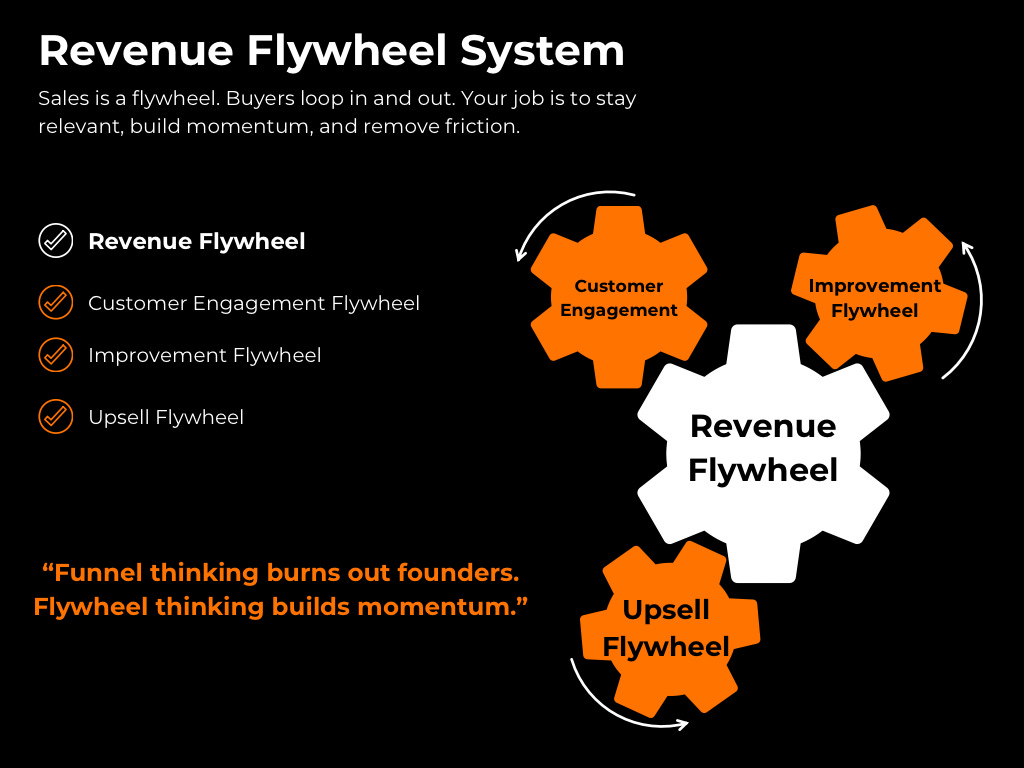
This is the Upsell Flywheel: how you keep the Revenue Flywheel turning year after year with the same customers, by layering additional value on top of the trust you’ve already earned.
We’ve already covered:
• The Customer Engagement Flywheel — how you diagnose before you prescribe.
• The Improvement Flywheel — how you ship small, visible wins that build belief.
This week, we’ll focus on the third gear:
Turning today’s win into tomorrow’s next step, without feeling “salesy.”
But first, a small ask…
Know someone struggling to bring additional value to their existing customers?
Share this post so we can all get a little better this week.
Have you subscribed yet? No? Do it now so you don’t miss out on any of the upcoming articles. Including how to tie all the flywheels together!
Diagnose Expansion Fit
Expansion readiness isn’t random. It’s patterned.
Once you’ve delivered real value, you’ll start to see gaps you’re uniquely positioned to solve. Not because you’re guessing, but because you’re close to their metrics, their workflows, and their priorities.
Your job is to turn those gut feelings into a simple rule. When 2 of these 5 triggers fire, the account is Upsell Ready:
Usage peaks – they’re at 80–90% of capacity or constantly bumping into limits.
Adjacent team requests – another department asks for access, reports, or “a quick demo.”
New initiative alignment – they’re launching something your product can accelerate.
Budget opening – new quarter, freed-up budget, or unused credits appear.
Champion movement – your internal advocate gets promoted or changes scope.
Tag these signals in your CRM. Don’t wait for them to “ask about expansion.”
You’re laying breadcrumbs so the upsell feels like the obvious next step, not a surprise pitch.
For the full breakdown:

Prescribe the Next Win
More choices = more friction.
One clear outcome = faster yes.
By the time you’re upselling, your customer isn’t choosing between you and competitors. They’re choosing between your next step and doing nothing.
They already trust you. Don’t make them sort through a catalog. Show them the next move. Your offer menu has only three plays, each tied to a 30-day outcome:
Adjacency Bundle – Add a related workflow so their system feels complete, not fragmented.
Seats / Usage Expansion – When usage peaks or another team leans in, extend access so momentum doesn’t stall.
Second-Team Pilot – When a new department is curious, give them a low-risk, time-boxed trial.
Each offer should answer one question:
“In 30 days, how will this make us better?”
Keep the offer simple. Tie it to one outcome. Remove friction so saying yes feels obvious.

Deliver the Micro-Pilot
A great pilot doesn’t prove your product. It proves the next fit.
You’re not running a pilot to “see what happens.” You’re testing whether this next step is worth scaling for this customer, right now. That’s why your micro-pilot needs four things and nothing more:
One KPI – A single metric tied to business value, not feature usage.
One Owner – One accountable person on your side and one on theirs.
One Success Signal – A clear “if we hit X, we move forward” line in the sand.
One Weekly Rhythm – Short check-ins to show movement, remove friction, and keep momentum.
Timebox it: 30 days… Not 90. Not 180.
In 30 days, you should know one thing:
“Is this the next problem we should be solving together?”
If yes, you scale.
If no, you stop fast, learn, and redirect the flywheel to the next best opportunity.

Re-Engage & Amplify
A pilot that converts is good. A pilot that becomes a story is growth. A pilot that becomes a referral is a flywheel.
Most teams stop at, “The pilot worked.”
You can’t. Every successful pilot should automatically turn into four assets:
One-slide before/after – Baseline → outcome → 30-day delta → one line of context.
3-line quote – Signal → fix → outcome, in your champion’s words.
90-second Loom – A quick walkthrough of the delta and what changed.
Referral script – A 30-second “we ran this, it worked, you should talk to them” template.
This is how you turn one outcome into:
More expansion with the same customer
More proof for the next customer
More referrals that keep your revenue flywheel spinning

Action Step
Pick one account showing 2 of the 5 expansion triggers. This week:
Design a 30-day micro-pilot: 1 KPI, 1 owner, 1 success signal.
Send the offer as a simple, outcome-based next step (no more than 2 options).
Commit: If it converts, turn the win into a 1-slide before/after, 3-line quote, and 90-second Loom.
One account. One pilot. One win you can turn into three.