

TFT: Borrowed Trust Beats Headcount
If partners can sell your value when you’re not in the room, growth no longer depends on headcount.

You built the partnership deck. You had the alignment call. You agreed to “collaborate.” Six months later, you’ve gotten zero introductions.
Here’s the question I ask to make sure the partnership is worth the investment.
Will this partner ever put their credibility on the line to introduce me?
If yes, build the motion.
If no, stay friendly but don’t bet growth on it.
Here’s how to make that trust transferable: turn it into a motion.
I was already winning work and the outcomes were visible. Champions were built.
When another opportunity came up for me that I was not expecting. It turns our my partner from the previous work recommended me here too.
Not because we had the biggest team.
Because we’d earned trust with the introducer and made it safe for them to put their name on it.
This post breaks down:
Why partnerships stall (and the 3 failure modes)
The 3-step framework to make partner selling shippable
A copy/paste partner script + “when to introduce me” checklist
The best partnership growth isn’t hustle. It’s borrowed trust.

The Partnership That Never Ships
Here’s the pattern I used to use for my “partnership strategies” and it would stall out.
I would want partnerships. So I would:
They book a few calls.
Everyone’s excited.
They agree to “collaborate.”
Then nothing happens.
Because the partnership never becomes a shippable motion.
As I was reflecting on my previous partnerships, I realized 3 things were causing my partnerships to die:
No trigger
There’s no clear “when to bring me in” moment.
So even if they like me, they don’t think of me at the right time.
No packaged handoff
My partner could not communicate my value prop in their words.
They understood what I do, but they can’t start the sale without me.
Too much buyer friction
The “partner play” added meetings, handoffs, and confusion.
The buyer experiences it as complexity. They just want a solution
A real partnership is a repeatable sales motion that someone else can run without you.
If you can’t write the motion down in 3 steps and point to the exact handoff moment, you don’t have a partnership yet. Good news is we are going to learn a framework today that will help you with that.
Here’s what six months of fake partnerships costs you:
Wasted alignment calls
Decks nobody opens
“Let’s circle back” emails that never close.
Meanwhile, founders with real partner motions are getting warm introductions every week without lifting a finger. The gap compounds.
The Filter I Use When Investing in Partnerships
Before I invest in any partnership, I ask one question:
Will this partner ever put their credibility on the line to introduce me?
That’s the whole test.
If the answer is yes, build.
If the answer is no, keep it friendly, but don’t build your growth plan on it.
The partnerships that work have three signals:
They already have trusted access to my buyer
They can describe the problem I solve without me in the room
They believe I’ll protect their relationship.
The partnerships that die look different:
We did one webinar together
We like each other
We said we should “collab” sometime
The difference? One is built on shared risk. The other is built on shared calendars.
Partnerships aren’t made in shared content. They’re made in shared risk.
The Trust Transfer
Here’s the business case where I learned the true value of partner selling. To protect the identity of the innocent (or guilty) I had to go with generic company names.
I had momentum with a manufacturing team. We were delivering. The results were visible.
But the bigger win was upstream:
I wasn’t just building trust with the customer.
I was building trust with the marketing agency as well. They now saw how I worked, communicated, handled risk, and represented the broader org.
So when that marketing agency was working with another manufacturing firm and they spotted a similar gap, they didn’t hesitate.
They already knew:
I wouldn’t embarrass them
I’d show up prepared
I’d protect the relationship
I’d solve the actual problem (not just pitch a product)
They could solve another problem for their customer, by bringing me to the table.
That’s what a warm introduction really is.
It’s not, “Hey talk to David.”
It’s, “This team will take care of you and they’ll make me look smart for introducing you.”
The Framework I Use to Outgrow Bigger Teams
That second introduction taught me something: borrowed trust is repeatable if you build the right motion. Here’s the framework:
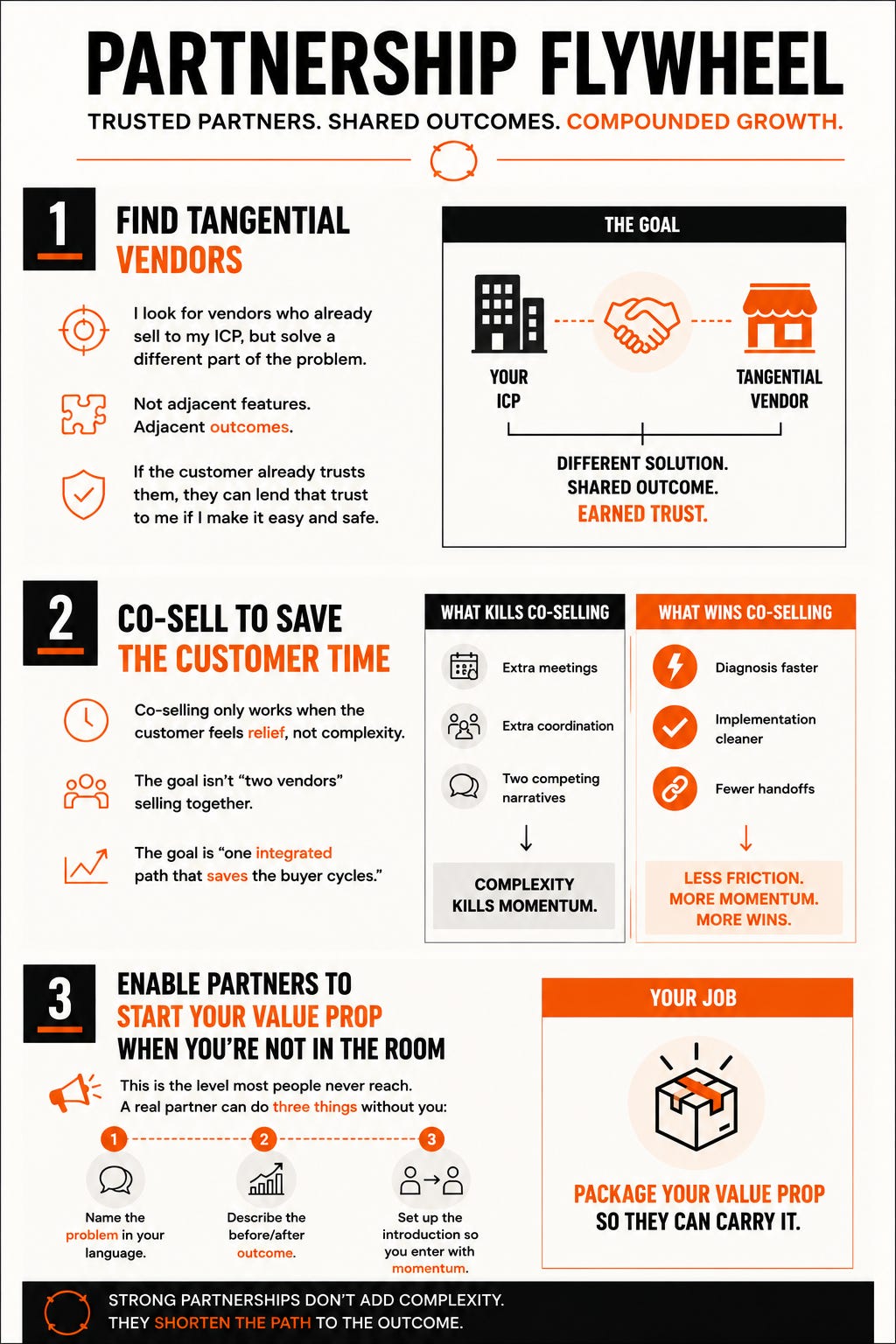
1) Find tangential vendors
I look for vendors who already sell to my ICP, but solve a different part of the problem.
Not adjacent features. Adjacent outcomes.
If the customer already trusts them, they can lend that trust to me if I make it easy and safe.
2) Co-sell to save the customer time
Co-selling only works when the customer feels relief, not complexity.
The goal isn’t “two vendors selling together.”
The goal is “one integrated path that saves the buyer cycles.”
If your partnership creates extra meetings, extra coordination, or two competing narratives, it dies.
But when the partnership collapses steps (diagnosis faster, implementation cleaner, fewer handoffs) buyers want you both involved.
3) Enable partners to start your value prop when you’re not in the room
This is the level most people never reach.
A real partner can do three things without you:
Name the problem in your language
Describe the before/after outcome
Set up the introduction so you enter with momentum
Your job is to package your value prop so they can carry it.
Think:
a one-page “when to bring us in”
a short script (“If you’re seeing X, David’s team fixes it by doing Y”)
a simple diagnostic question set
2–3 proof points they can repeat confidently
If your partner can’t explain your value in 20 seconds, they won’t sell for you when it counts.
What to Do When the Trust Isn’t There Yet
Sometimes you find the right partner, but the trust transfer isn’t earned. It does take time after all.
Don’t force the introduction. Don’t ask for referrals early.
Earn the right to be recommended.
The fastest path I’ve seen:
Do one small co-sell motion with a tight scope
Over-communicate
Make the partner’s life easier
Deliver a visible win
Debrief together and codify what worked
Trust is a track record.
Action Step
Pick one partner you could grow through this quarter and answer the following:
What outcome do we both serve (in plain English)?
What co-sell motion would save the customer time?
What enablement asset would let them start my value prop without me?
This week, write a 10-line partner enablement script:
2 lines: the problem
2 lines: the “from → to” outcome
2 lines: who it’s for
2 lines: proof
2 lines: how to intro you
If they can’t repeat it, they won’t refer you.
Where AI Can Help
Paste this into AI:
“Here’s my offer and who I serve. Here are two partner types: marketing teams and sales managers. Write (1) a 20-second partner script, (2) a ‘when to introduce me’ checklist, and (3) three co-sell plays that save the customer time. Keep it simple and repeatable.”
AI drafts. Humans decide. Trust is the asset.
I like how this reframes partnerships from “networking” into risk transfer.
Most introductions fail because trust is contextual. People will only stake their reputation on you when they believe the interaction will reflect well on them too.